Vocal Reverb Settings: Type, Pre-Delay and Decay
How to make vocals sound spacious without washing them out: which reverb to use, the pre-delay and decay settings that work by genre, and how to keep the words clear.
- Put reverb on a send (aux/bus), set 100% wet, and blend it in with the send level.
- Plate reverb is the classic vocal choice: about 1.2–1.8 s decay for pop, shorter for intimate R&B.
- Pre-delay of 20–60 ms keeps the start of each word dry and clear.
- EQ the reverb return: high-pass around 200–400 Hz and low-pass around 6–10 kHz.
- De-ess before the reverb so "s" sounds don't splash across the tail.
Vocal reverb settings by genre
Starting points for the lead vocal. Adjust decay to the tempo and density of the song: slower, sparser songs can carry longer tails.
| Genre | Reverb type | Decay | Pre-delay | Notes |
|---|---|---|---|---|
| Pop | Plate | 1.2–1.8 s | 30–60 ms | Often paired with a quieter, longer hall for depth. |
| Hip-hop / rap | Short room, or none | 0.4–0.6 s | 0–20 ms | Keep the verse dry and upfront; use delay throws instead. |
| R&B / soul | Room or plate | 0.8–1.2 s | 25–35 ms | Warm and intimate; the space should feel physical. |
| Indie / alt | Short plate or room | 0.8–1.5 s | 20–40 ms | From dry and close to roomy and vintage, depending on the song. |
| Ballads | Plate + hall | Plate 1.5–2 s, hall 2.5–3.5 s | 40–80 ms | Longer pre-delay keeps the vocal close even with a big space. |
| Electronic | Plate or hall | Short for club, long for ambient | 20–60 ms | Try ducking the reverb so tails drop while the vocal sings. |
Which reverb type for vocals?
- Plate: bright, dense and smooth. The most common vocal reverb because it adds sheen without sounding like a specific room.
- Room: short and natural. Places the vocal in a believable space without an obvious tail.
- Hall: large and long. Beautiful for depth and ballads, but keep it lower in level so it doesn't wash out the words.
- Chamber: between room and hall; warm and slightly dense.
- Spring: twangy and lo-fi. More of a character effect than a space.
Pre-delay: the setting that keeps vocals clear
Pre-delay is the gap between the dry vocal and the start of the reverb. With no pre-delay, the reverb starts at the same moment as each consonant and blurs it. With 20–60 ms, you hear the word first and the space right after, so the vocal stays upfront even with a lot of reverb.
You can also sync pre-delay to the tempo. One beat in milliseconds is 60,000 ÷ BPM, so at 120 BPM a beat is 500 ms, a 1/16 note is 125 ms and a 1/32 note is about 62 ms.
See every element on one map
MixMap plots all of this for 63 elements across Pop, Hip-Hop, R&B, Electronic and Indie: frequency, pan, width, level, compression, reverb and delay. Click an element to get its settings.
EQ the reverb, not just the vocal
A reverb return full of low end makes the mix muddy, and bright tails sound harsh and sibilant. On the reverb channel:
- High-pass around 200–400 Hz to remove low-mid build-up.
- Low-pass around 6–10 kHz so the tail sits behind the vocal instead of fizzing on top.
- De-ess before the send, or put a de-esser on the reverb return.
Two reverbs are often better than one
A common setup uses two sends on the lead vocal: a short plate or room for presence and glue, and a longer, quieter hall that you feel more than hear. The short reverb makes the vocal sit in the mix; the long one adds depth without washing out the words.
Make the reverb move with the song
- Reverb throws: automate the send up on the last word of a phrase so it blooms into the gap.
- Ducking: sidechain a compressor on the reverb return to the dry vocal. The tail dips while the singer sings and swells in the gaps.
- Section changes: drier verses and wetter choruses make the chorus feel bigger.
Reverb vs delay
Delay adds depth with less wash, which is why rap and upfront pop vocals often use it instead of long reverb. A slap delay of about 60–120 ms, or a tempo-synced 1/8 or 1/4 note filtered with a high-pass around 300 Hz and a low-pass around 6 kHz, adds space while keeping the words clear.
Common vocal reverb mistakes
- Reverb on the vocal insert instead of a send. You lose control of the balance and can't share the space with other parts.
- Setting the level in solo. Reverb that sounds right in solo is almost always too much in the mix.
- Tails that run into the next line. Shorten the decay or duck the reverb.
- Different spaces for lead and harmonies. Send harmonies to the same reverb (perhaps a little more of it) so they sound like one performance.
MixMap — The Complete Mix Reference
Stop searching for the same settings every session. One interactive reference with starting points for every element in 5 genres, with pan values for Logic, Ableton, FL Studio and Pro Tools.
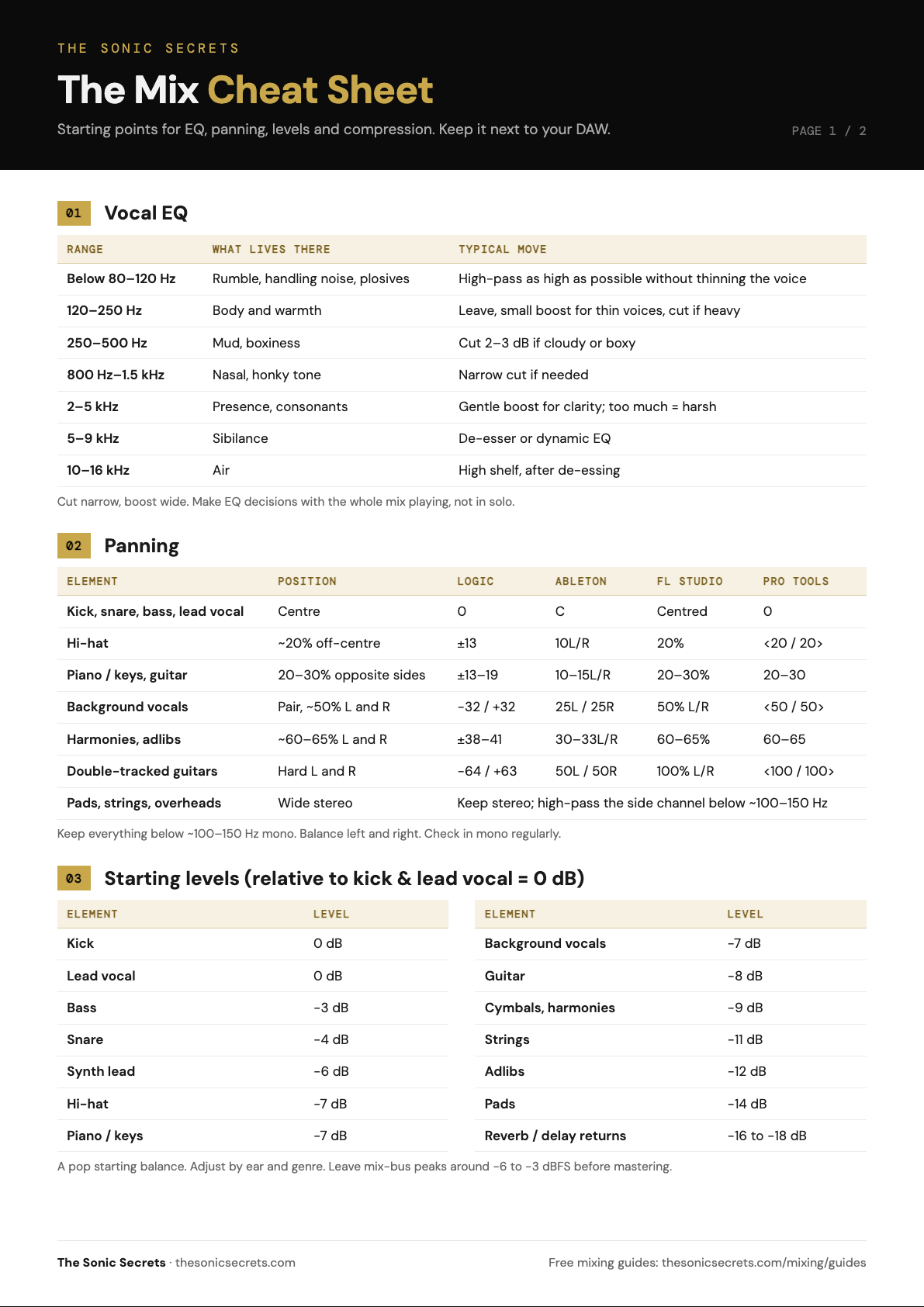
Get the 2-page Mix Cheat Sheet
Vocal EQ, panning with DAW values, starting levels, compression and reverb settings on two printable pages.
Your cheat sheet is ready. A copy is on its way to your inbox too.
DOWNLOAD PDF →Need exact numbers for your tempo? The free Delay & Reverb Time Calculator turns any BPM into tempo-synced pre-delay, decay and delay times.