How to Mix Kick and Bass (and Tune Your 808)
Kick and bass fighting for the same space is the most common reason a mix sounds muddy or weak. Here's how to give each its own space, step by step.
- Decide who owns the sub. Usually either the kick or the bass/808 carries the lowest frequencies at any moment, not both.
- Carve complementary space with EQ: if the kick's weight is at 60 Hz, dip the bass slightly there, and the other way round.
- Sidechain the bass to the kick so the bass ducks briefly on each hit.
- Tune the 808 to the key of the song before you EQ anything.
- Add harmonics (saturation) so the low end is audible on phones and laptops.
Where kick and bass live
| Range | Kick | Bass / 808 |
|---|---|---|
| 30–60 Hz | Sub weight (felt more than heard) | 808 and sub-bass fundamentals |
| 60–100 Hz | Main punch and weight | Fundamental of most bass notes |
| 100–250 Hz | Body and warmth | First harmonics, warmth, "growl" |
| 250–500 Hz | Boxiness, often cut | Can build up mud with guitars and keys |
| 700 Hz–1.5 kHz | Rarely important | Audibility on small speakers (string noise, harmonics) |
| 2–5 kHz | Beater click and attack | Pick or pluck attack |
Step 1: decide who owns the low end
Kick and bass fight when both try to be loudest at the same low frequencies at the same time. Pick a role for each:
- Sub-heavy bass, punchy kick: the bass or 808 owns 30–60 Hz; the kick focuses on 60–100 Hz punch and its click.
- Deep kick, tighter bass: the kick owns the sub; high-pass the bass a little and let its 100–250 Hz warmth define it.
In trap and much modern hip-hop the 808 is the bass. If a separate bass instrument exists, keep it in roughly the 80–200 Hz range and leave the sub to the 808.
Step 2: carve space with EQ
Solo the kick and bass together and sweep a narrow boost between 40 and 150 Hz. Find where the kick's weight sits, then make a small dip in the bass at that frequency, and a small dip in the kick where the bass is strongest. Two 2–3 dB cuts usually beat one big cut.
Then clean up everything else: high-pass guitars, keys, pads and vocals so they don't add low-end build-up under the kick and bass.
Step 3: sidechain compression
Put a compressor on the bass and feed it the kick as the sidechain input. Each time the kick hits, the bass dips for a moment, so the kick punches through. Settings to start from:
- Attack: fast (0.1–5 ms) so the dip lands with the kick.
- Release: about 100–300 ms. Set it so the bass is back just before the next kick; this timing shapes the groove.
- Depth: 2–4 dB of gain reduction for a subtle mix; much more for the audible "pumping" of house and EDM.
Alternatives: a volume-shaper plugin, or a dynamic EQ that ducks only the bass's low frequencies when the kick hits.
See every element on one map
MixMap plots all of this for 63 elements across Pop, Hip-Hop, R&B, Electronic and Indie: frequency, pan, width, level, compression, reverb and delay. Click an element to get its settings.
How to tune your 808
An 808 is a pitched note, not just a drum. If it's out of key, the whole song sounds slightly wrong, which is one of the most common problems in beginner trap and hip-hop mixes.
- Find the key of the song from the chords or melody.
- Find the 808's pitch. Put a tuner or spectrum analyser on the 808 and play it; many sample names also include the note.
- Retune the sample with the sampler's pitch/transpose control so its root note matches the key (often the root of the song).
- Program the 808 notes to follow the bassline or chord roots, not just a single pitch.
- Check against the melody. If the low end beats or sounds sour, it's still out of tune.
Long 808s overlap with each other and with the kick. Use a mono, legato setting (or glide) so notes don't stack up, and shorten tails that smear into the next hit.
Make the low end translate to small speakers
Phones and laptop speakers barely reproduce anything below about 100 Hz. If your bass disappears on them, don't add more low EQ. Add harmonics instead:
- Saturation or distortion on the bass or 808 creates upper harmonics your ear hears as the same note.
- Parallel saturation: duplicate the bass, saturate the copy heavily, high-pass it around 200 Hz and blend it in quietly under the clean bass.
- Kick click: a little 2–5 kHz on the kick keeps its attack audible on any system.
Keep it mono and in phase
- Keep everything below roughly 100 Hz mono. Wide sub can cancel on mono systems.
- If you layer kick samples, zoom in and line up their transients, or flip polarity on one and keep whichever sounds fuller.
- Check kick and bass together in mono. If the low end gets thinner, something is out of phase.
Kick and bass by genre
- Trap / hip-hop: the tuned 808 is the bass; kick often short and clicky, sometimes layered with the 808.
- House / techno: kick-to-bass sidechain is part of the groove; its release time sets the pocket.
- Pop: punchy, clean kick with the bass mono below about 150 Hz; saturation for small-speaker translation.
- R&B: rounder, warmer kick with slower compressor attack; melodic bass with its dynamics intact.
- Indie / rock: more natural kick with room sound; bass often a blend of DI and amp for definition plus grit.
MixMap — The Complete Mix Reference
Stop searching for the same settings every session. One interactive reference with starting points for every element in 5 genres, with pan values for Logic, Ableton, FL Studio and Pro Tools.
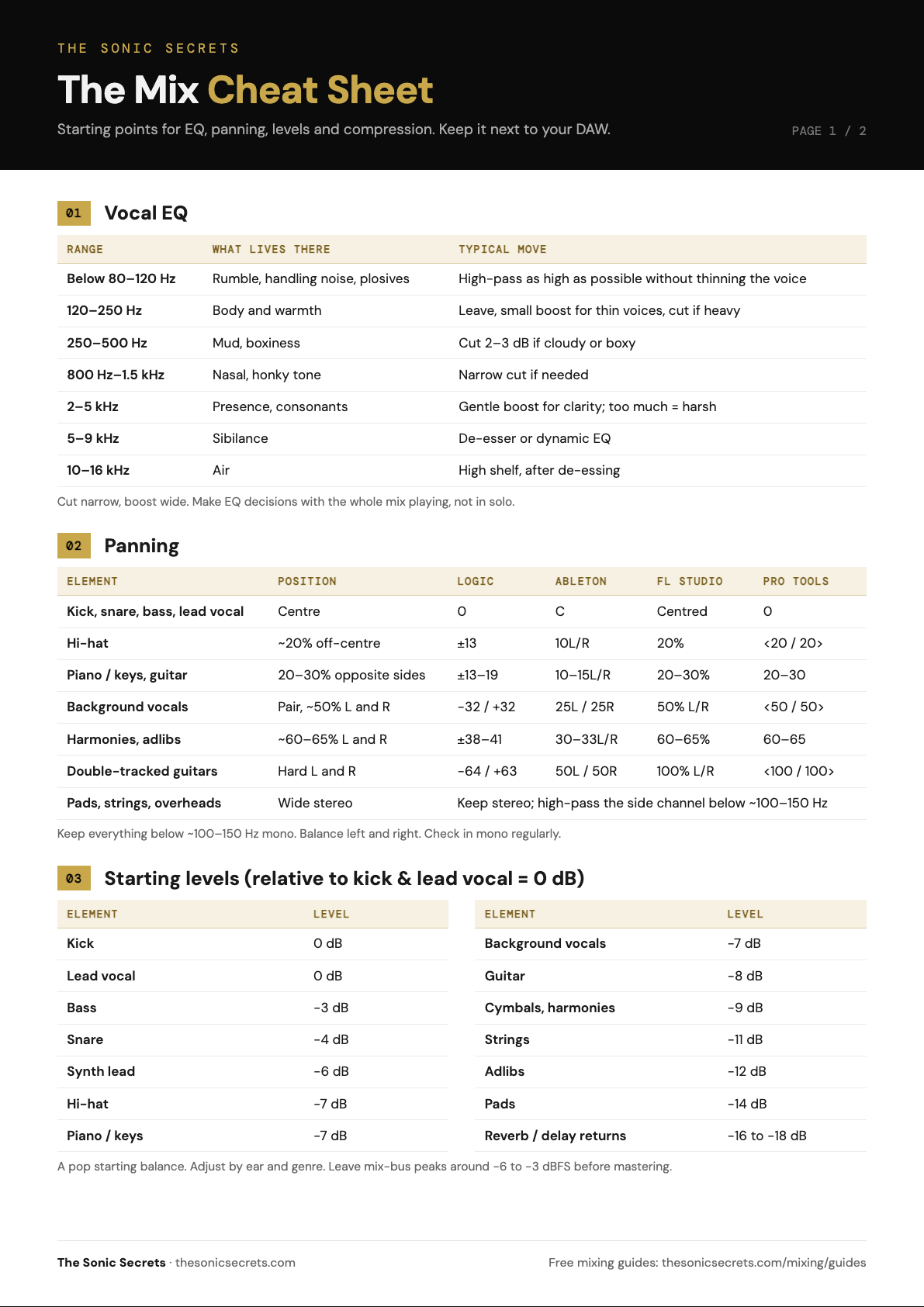
Get the 2-page Mix Cheat Sheet
Vocal EQ, panning with DAW values, starting levels, compression and reverb settings on two printable pages.
Your cheat sheet is ready. A copy is on its way to your inbox too.
DOWNLOAD PDF →Need the exact notes? The free 808 Tuning Chart lists every 808 note for your key, with frequencies in Hz and MIDI numbers.